
By Ruth Chiang
Actor, stunt performer and stunt coordinator Ruth Chiang chats with her 2025 Stunt Ensemble Award-winning peer, stunt coordinator John Stead, about how being a competitive fighter in martial arts led to his career in stunts, how AI will be a game-changer in the industry and why fear is important in stunt work (and more).
(12-minute read)
The Stunt Ensemble Award nominees and winners are decided by a jury comprised of ACTRA Toronto stunt community members. How does it feel to be honoured by a jury of your peers?
It feels great to be honoured by your peers. These are the people we go to work with every day. These are the [stunt] performers and coordinators who understand what it takes to do what we do. To be recognized by them for this award is truly a humbling experience. There are so many gifted people in our field, I feel fortunate to be counted among them.
How did you first start your career in stunts?
My career in stunts actually started in the theatre. I moved east to pursue fight directing. In fact, when I told people what it was that I wanted to do, most people confused it with becoming a stunt performer. It was then that I learned that such a job existed. I thought this was a fantastic opportunity, so I started applying to every stunt coordinator I heard about. I had no money in the beginning, so I used to photocopy my headshot and send it out to everybody via Special Delivery. In fact, I used to hear from many stunt coordinators that the only reason they opened my resumé was because it was sent in such an official manner. I would also invite them out to all the theatre shows I was doing as an actor combatant or stunt performer, or for the shows I was fight directing. I was getting a few stunt jobs here and there, but when it really took off for me was when I was hired by The Stunt Team, specifically Ted Hanlon, to do some sword fights for them on Beyond Reality. Ted brought in a stunt performer to do a high fall for me, and I told him I knew I could do that, so he let me do it. It was after that he started hiring me as a stuntman. It was Ted who first gave me so many opportunities, followed closely by Marco Bianco. For years, I balanced a career in both stunt performance in film and television and fight direction in the theatre.
What were your training and unique interests that led you down this road?
I attended the University of Saskatchewan and one of my classes was in the drama program. Since I was a competitive fighter in martial arts – specifically kickboxing, karate, as well as competitive saber – I ended up staging the fights for Greystone Theatre Productions. I loved doing it, and one of my professors at the time told me it was possible to do it professionally, if I moved out east to Toronto and worked in professional theatre companies. I had never imagined such a thing existed, but upon graduation I packed up and headed to Massachusetts, where I attended a three-week seminar on stage combat. I then headed to Toronto to try and make my way as a fight director. So, to answer your question more specifically, I was a fighter and that’s really how I got into it. I remember first learning about a very successful stunt performer and coordinator, Randy Butcher, because we [were featured together in] an article about martial arts for the stage, film and television in Black Belt Magazine. It was great to learn about someone else doing the same thing.
What are the greatest challenges you’ve faced in your career, both past and present?
Everyone jokes about how busy I am, but they weren’t with me in the very beginning when I was first starting out! I’d have to honestly say the biggest challenge in my career was simply trying to get my first jobs. I was struggling to be recognized. It’s funny because once it happened, the business was fantastic to me, but it was tough in the beginning. I suppose everyone’s story is the same, but those first few years were hungry.
You’ve worked with some great stunt coordinators, stunt performers and directors throughout your career. Is there anyone in particular who has had a strong impact on your life either professionally or personally?
Ted Hanlon and Marco Bianco. As I said before, it was Ted who first gave me my start on a regular basis. He gave me my first break. Then, I’d have to say Marco Bianco, from whom I learned so much about the craft. I still work with Marco today. You know, Marco is one of the best stunt riggers in the world, but people should remember that he was also a premier stunt performer and stunt coordinator. He has performed and coordinated some of the most fantastic gags our industry has ever seen. Not only am I proud to call him one of my mentors, but also a personal friend.
The industry continues to evolve on many different levels. What are the biggest changes you’ve experienced in your career, and how have they affected your work in stunts?
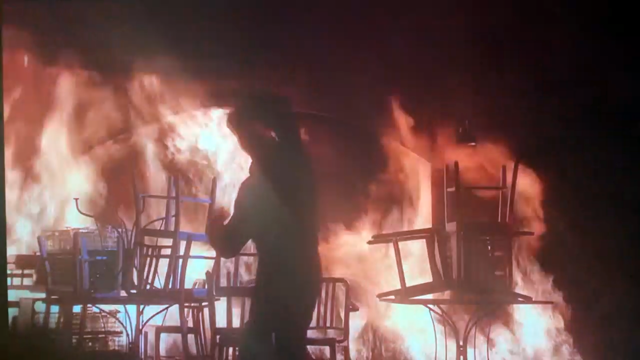
The advancements in CGI (computer-generated imagery). CGI has grown far more prevalent. For example, in the past, we’d spend hours planning how to blow out windows on a building and coordinate stuntmen diving from the debris. Today, people just walk by and the director says, ‘The top row of windows will blow,’ and we move on. It’s made life simpler in some ways, but also more complex at a technical level. CGI has made wire removal easy and affordable, whereas before we’d rely on low lighting and thin black wires to avoid costly effects. I think the ‘cowboy stunt’ days have changed drastically. You don’t see as many high falls into airbags or air rams. Now it’s mostly winches and CGI. Even ‘burns’ (gags involving fire) are often supplemented with CGI. The stunts are still there, but the way they’re executed has changed dramatically.
What new challenges will stunt performers face in the future?
Artificial intelligence (AI) will be the game changer. Once AI and CGI merge to perfect the DigiDoll, the question will be: why throw a person out a ten-storey window when you can generate it digitally? It will be cheaper and claimed to be safer, though really, it’s about cost savings. That may be the greatest threat to our industry.
Do you believe there are some things AI won’t be able to replace?
Honestly, I don’t. Very soon the technology will be indistinguishable. Look at films like Jurassic Park – CGI was already convincing, but with AI it will only improve. I truly believe AI will be the greatest single threat to the stunt profession.
So, could stunt performers become obsolete?
Perhaps in movies, but not entirely. I think there will always be a place for live stunt shows and daredevil acts. Audiences still want to see real people doing dangerous things. But in film, AI and CGI may dominate, unless audiences demand real stunts.
What is the most dangerous or challenging stunt you’ve ever had to perform or coordinate?
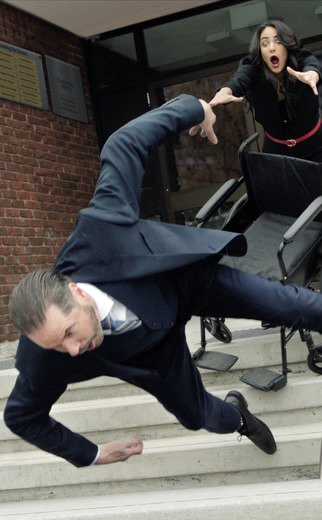
A toss-up would be between a gag where I had to cross a frozen lake and drop through the ice and another leaping from a burning building. For the ice gag, we literally cut a hole in the ice on an actual lake and I had to walk across the ice and fall through the hole. I couldn’t wear a dry suit because it was too buoyant, so we did it with a wet suit and weights to help pull me under. Once under, I shelved myself beneath the ice and then released the weights free. On one of the takes, I got turned around and couldn’t find the hole. I remember thinking “It’s got to be here somewhere, so stay calm and look for it.” The lighting was particular that day, and it completely obscured the hole. It was the stunt diver safety, Todd Shannon, who reached down and waved his arm for me [so I could] see the hole. As I swam to it, he grabbed me and pulled me up.
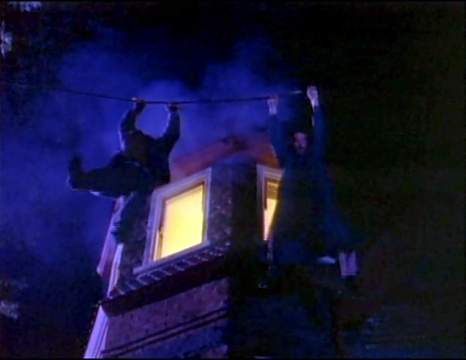
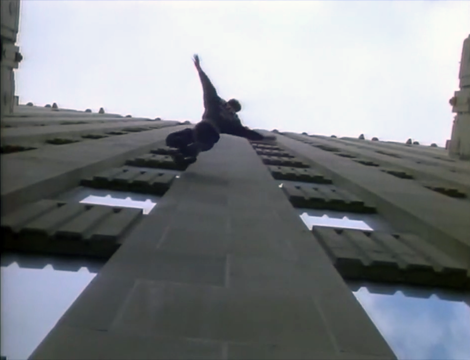
Another stunt was for a movie called TekWar. I was partnered with another stunt performer named Roy Anderson. The gag involved us diving from the third storey of a burning building, aiming to catch a rope 12 feet away and strung between two cranes. If one of us hit the rope first, it would have knocked it from the reach of the other. So, we had to hit it at exactly the same time. I remember Roy asking to take the count because he didn’t want to be the guy to push the rope away. You had to hit the rope, or we would have missed our box rig below. I remember during rehearsals we could barely make the 12 feet. But on the day of the take, we hit it so hard we caught it across our chest and exactly at the same time.
There was also a subway gag I did with Ted Hanlon. I was in the pit between subway tracks, and the train came racing toward me. At the last second, I had to pull myself up and out of the way. Ted said afterward, “There are some gags where you just have to have the right person in the pit.” It showed the importance of remaining calm and using whatever fear you felt to focus and sharpen your senses.
What about coordinating?
Yes, there was a gag I coordinated for XIII: The Series where a stuntman vaulted over a bridge and landed on a moving train 30 feet below. It required stunt rigging, airbags and exceptional skill from the performer. The performer was Matthew Ledoux, and the riggers were Marco Bianco and Tom Farr. The stunt was a success because of the extraordinary stunt team and detailed planning involved.
Were there times when safety rigs or wires got in the way?
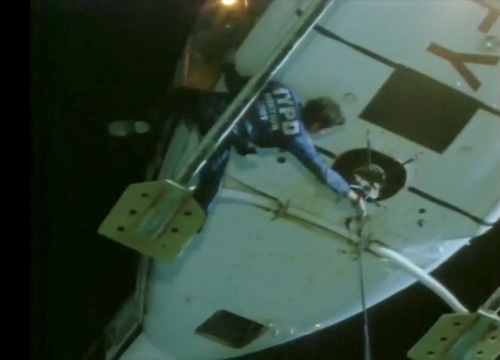
Yes, sometimes safety rigs can be a hazard. For example, I did a gag with Marco Bianco where I had to climb out of a flying helicopter, position myself on the landing struts, reach below to grab a cable hanging from the centre of the underbelly, swing over to it, slide down the cable and pursue a moving truck. Once I was over the truck, I had to let go and land on its roof. The rigging got in the way, so I said to Marco, “Forget the lines,” and we did it without rigging. It worked perfectly.
I also remember another stunt Mathieu Ledoux did for me. It involved a rapid descent inside a factory down 50-60 feet of various levels of machinery to the floor below. I was working out the rigging plan, but Mathieu insisted on doing it live. He was an expert at parkour, and he executed a tic-tac descent all the way to the floor in mere seconds. It was breathtaking, and he nailed it live without any rigging.
How important is fear in stunt work?
Fear is an important component in what we do. People think stunt performers must be fearless – that’s not true. Fear sharpens and focuses you. Good stunt performers have fear but they use it. You focus it and then execute the stunt. On the flip side, complacency is deadly in our industry. I remind performers all the time. It only takes a moment of relaxing for disaster to strike.
Looking back on your career to date, is there anything you would have done differently, and what advice would you give to new stunt performers entering the industry?
I’m not much for looking back and wishing I’d done things differently. No apologies, no explanations. Mistakes shaped me into who I am. As for advice: don’t have a plan B. No backup. If you want to be a stunt performer, then be a stunt performer. Commit fully – no halfway. The real stunt performer is all in. Because often when people say they want to get into stunts, what they’re really interested in are the softer things. They don’t want to get hit by cars, or be set on fire, or do a car roll or a high fall. But the real stunt performer wants those gags. They want to earn their place. True stunt performers do real stunts.
Ruth Chiang has been stunting, acting and, more recently, stunt coordinating in the film and television for over 25 years. Recent projects include Law & Order Toronto: Criminal Intent seasons 1-3 (including serving as Assistant Stunt Coordinator on the 2025 ACTRA Awards in Toronto Stunt Ensemble Award-winning stunt in episode “The Key to the Castle”), SkyMed seasons 1-4, Hudson & Rex, Saint-Pierre, The Testaments and Ithaqua.